I Get Knocked Down but I Get Up Again Lytics Meaning
The twelvemonth is 1997. You are listening to the car radio. You are at a party. You are at a bar, the drug store, a wedding, your bedroom, or in your living room watching TV. It doesn't matter where you were considering information technology was everywhere, beingness sung by everyone. It still hasn't stopped.
Your dad was banging his head to the vanquish. "I get knocked downward / Just I get upward again / You are never gonna proceed me down." (Dads lived for this vocal.) But your mom chimes in, besides, inconversable and feeling a little bit naughty as her falsetto kicks in: "Pissing the night abroad…"
Meanwhile y'all, your friends, and your siblings have been doing your studious best to memorize the right social club of things, as if you were clocking times tables or land capitals. "He drinks a Whiskey drink / He drinks a Vodka drink / He drinks a Lager drink / He drinks a Cider drink."
Even Barbara Walters was leading the audience of The View in a chant.
Aye, it was 1997. The NASA Pathfinder had landed on Mars. The Hale-Bopp comet had its closest arroyo to Earth. A boy-wizard named Harry Potter was being introduced to readers, the world was mourning Princess Diana, O.J. Simpson was constitute guilty, Mike Tyson flake an ear, and a repose, tiny pic called Titanic hit theaters. And through it all? Nosotros were "Tubthumping."
The massive hitting from British rock band Chumbawamba has, in the 25 years since information technology start set up a permanent residence on the airwaves and in our commonage brains—where information technology will live until the world ceases to be—been considered one of the quintessential examples of a "ane-hit wonder." The song was as inescapable equally a person'south own shadow. Even now, all these years, fads, and musical tastes afterward, you'd be hard-pressed to detect a person not amped to belt-scream every discussion.
But what if we are the ones who were confused? Or perchance misled. Misinformed. Perhaps, even, oblivious. A ane-striking wonder? Technically speaking, yeah, that'south what Chumbawamba was. Just in reality, the group—and that song—were and so much more. For over a decade earlier "Tubthumping" was a mainstay on the radio alongside the Spice Girls, Oasis, and Toni Braxton, the group was one of the most noted anarcho-punk bands in Europe. "Tubthumping" was a hitting, but information technology was likewise a Trojan equus caballus.
Make whatsoever you want out of that anthem. Tune in to run across them on your favorite talk shows. Just in turn, you're exposing yourself to the deeper bulletin of a politically pissed off, dissenting, fed-upward band of musicians who had a thought: What if we made a record that took us to the mainstream, and so we subverted it all? What if, by masquerading as popular stars, we could change the globe?
There's possibly an fifty-fifty more pressing question, asked with the context of fourth dimension all these years after. Basically: Did it work? And if not, was the endeavour even worth it?
That'southward what the new documentary, I Get Knocked Downwardly, is concerned with. The film played this weekend at the SXSW Film Festival, and counts Chumbawamba member Dunstan Bruce as its co-manager, central figure, and existential inquisitor.
The film is squarely not a talking-heads history of Chumbawamba, or whatsoever sort of hagiography. There are surreal hauntings from a behemothic human wearing a plastic version of the demonic babe head that appeared on the group's big album, Tubthumper. The moving picture revisits every major anarchic stunt the group pulled while information technology had the world's attention, and it's a creaky-knee crunch of aging, with Bruce wondering what role he can still play in a motion of change—and if bringing Chumbawamba and its mission back into public consciousness could assistance the fight.
"We took a lot of the spirit of what Chumbawamba was most: ever trying to modify what we do, always trying to surprise our audience, and ever trying to do something different," Bruce tells The Daily Creature. "And I think that's what we tried to do with the movie."
Bruce is not what you lot might imagine when you think about punk anarchists who are nevertheless fighting the good fight. There's no all-blackness ensemble, renegade hairstyle, or canvas of tattoos proudly on display. Instead, his uniform consists of some of the most envy-inducing bespoke suits a proper dapper man could wish for, equally well every bit a trendy haircut that'll have you reaching for a hat to cover upwards your ain unworthy mop.
Fifty-fifty his I Go Knocked Down co-manager, Sophie Robinson, refuses to believe that he wasn't wearing dungarees or a crazy lid when they offset met. Sure, we might have preconceived notions of someone, but people modify. Only a natty double-breasted blazer can't conceal the unbridled spirit that, decades later, withal burns bright underneath. It's that spirit, not to mention how to apply it for good and for proper impact, that Bruce is concerned with.
We're meeting the afternoon post-obit the film's SXSW premiere in Austin. He drinks an oatmeal latte drink. I drink a cold brew drink. (Even anarchists make sensible drinkable choices in one case they reach a certain historic period, lyrics be damned.)
Merely the conversation, it actually is about what happens when you become knocked down then get up once again. And wondering if, times seeming as dire and hopeless every bit they do, it's possible to all the same defy and maintain that they're never gonna keep us down.
"Nosotros're enlightened of the fact that the motion picture is very niche," Bruce says. "There's this phrase in the U.M., where you say, 'It's a chip Marmite,' which means y'all either completely love information technology, or yous completely hate it." It's a polarizing reaction that he'due south spent nearly four decades getting used to—and relishing.
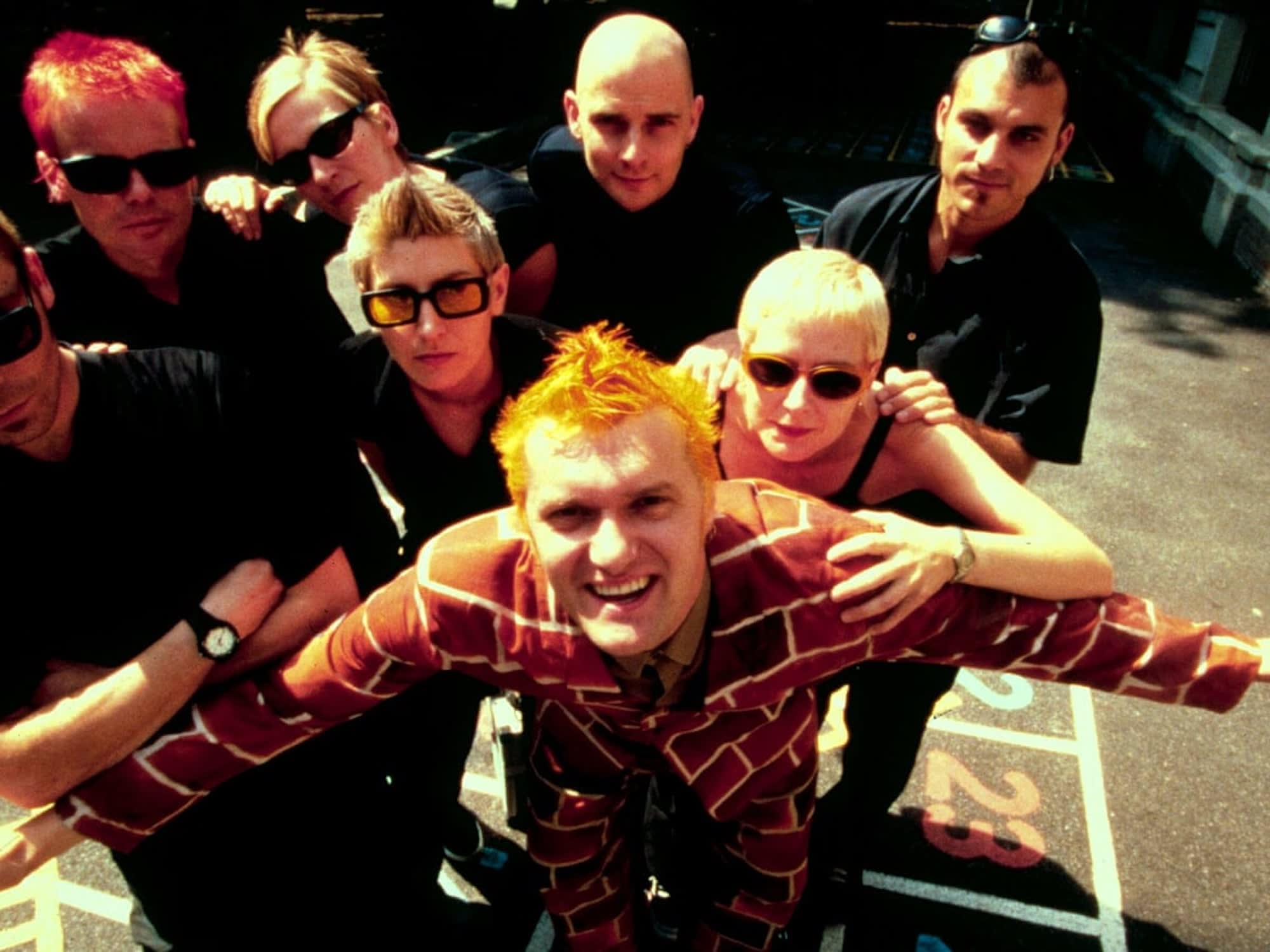
The band Chumbawamba in their heyday
Shutterstock
Here are some things that Chumbawamba did while having the almost popular song in the world:
Band member Alice Nutter spoke confronting the miscarriage of justice past maxim that she and the grouping "like it when cops go killed." On Bill Maher's Politically Wrong, she encouraged people to steal their CD from major retailers who didn't need their money.
When brands came calling to license the song commercially, they agreed to the opportunities, but cheekily. General Motors paid nearly six figures to use a Chumbawamba vocal in an ad. The group then donated the coin to anti-corporate activist groups.
During their performance on The Late Bear witness With David Letterman, they added a verse to "Tubthumping" advocating in back up of decease row prisoner Mumia Abu-Jamal. When they performed at the BRIT Awards during the Liverpool Dockworkers' Strike, they inverse the "Tubthumping" lyrics to, "New Labour sold out the dockers, just like they'll sell out the residuum of us."
At the anniversary, singer Danbert Nobacon climbed on one of the banquet tables, lifted a bucket filled with ice water meant to arctic vino and champagne, and dumped it over the head of Great britain Deputy Prime Minister John Prescott.
And that's not to mention the two decades of smaller-scale stunts that preceded their time on the globe stage.
Part of Bruce's insistence on non creating a music-dr. hagiography of Chumbawamba meant asking humble questions. The biggest one: Did whatsoever of that affair? Or, rather, did anyone even discover?
Even the record label president who signed the band wonders in I Get Knocked Down if all the stunts went over the heads of fans, who listened to the song on pop radio and possibly had no idea of their long history of activism.
"I think in that location was a lot of that, yep," Bruce says. "People but idea nosotros were a novelty act from England and but enjoyed u.s.a. for what it was. And so the song was adopted by everything I despised about sports culture. It got adopted by jocks everywhere."
Merely even the record characterization was inadvertently in on the Trojan-horse mission. The song was so popular that Universal released a limited edition single of the track, back when people bought singles. It was a cynical marketing ploy, but it paid off in the band's favor. "When they ran out, it made people buy our anthology. That gave people the chance to heed to the message and our record."
The fact of the affair is, though, that "Tubthumping" was a radio staple alongside the likes of "Quit Playing Games With My Eye" by Backstreet Boys, "Wannabe" by Spice Girls, "Foolish Games" by Gem, and even the Princess Diana tribute vocal "Candle in the Current of air" by Elton John. It'due south safe to say that the target demographic may non have been primed to search for political meaning in the Chumbawamba song that joined that playlist.
"'MMMBop' was at the same fourth dimension as us," Bruce says. At one point Chumbawamba was booked on the same concert bill at a theme park with Hanson, the group of gee-golly, barely pubescent brothers from Oklahoma singing in harmony. "That'due south how bonkers information technology got for us. It was 1 of those moments where yous call back, 'Are nosotros doing the right thing here? Should we notwithstanding be doing this?'"
The answer was yeah, but it wasn't an easy aye. Information technology was a qualified yeah. It mattered to the group what they were going to practise with all of the opportunities—theme parks or otherwise.
Chumbawamba was big on the radio station concert circuit at that time. The end-all, be-all of that is New York'due south Jingle Ball, which is put on each holiday season by the massively influential Z100 station at Madison Square Garden. That year, Chumbawamba was on the neb alongside all of those aforementioned pop acts. They brushed shoulders backstage with Céline Dion and Aerosmith.
"That's how bonkers information technology got for us. It was i of those moments where you think, 'Are nosotros doing the right affair here? Should we still be doing this?' "
Part of the gimmick at the result was a second stage in the middle of the arena that was fashioned to look like a boxing ring. That's where Chumbawamba was booked. The grouping wanted to stay true to themselves, popular-star coronation be damned. So they opened their set by singing an a capella anti-fascist protestation anthem. (And then transitioned into "Tubthumping.")
"We were e'er trying to subvert the mainstream," Bruce says. "And it was difficult. It was hard. But we had a lot of fun trying. I think that'southward all you can do, really. I think you just have to let the message exist that 'at to the lowest degree we tried.' At least nosotros tried to do something. Whether we were successful or not, I'm non the one to estimate us. But I call back my measure is at least we tried to do something."
As generous as "at least nosotros tried" is, it'south hard for Bruce to justify it. He wants more. He always wanted more. In part, that's why he made I Get Knocked Down.
The other members of Chumbawamba's stories weren't his to tell—though they're the unicorn band in which all former members are still in touch. At that place's a group text. They ship each other funny videos of people roofing "Tubthumping." (You'd die at the a capella show choir's interpretation.) They accept Christmas dinner together. Only his story, his angst, that's what I Become Knocked Down was inspired by.
Dunstan Bruce isn't a fool. He knows he's somebody who used to exist somebody. He knows that he was a pop star who wanted to change the world, and he knows that's a ludicrous argument. When the documentary references a like quote/mission statement from Lady Gaga, it's played for laughs, but it's besides brought up in reverence. That, truly, is a noble pursuit.
At its most bones level, 20-plus years later his Chumbawamba days, Bruce was feeling one-time and useless. The globe was, as he says, going to "hell in a handcart." He felt outraged, yet impotent. So much of his life was spent trying to make a difference. All these years later, things felt similar they were back at ground zero. Trying to gear up it all wasn't just a business organization. It never was. It was a calling. A mid-life crisis, perhaps, was arriving. Or perhaps it was a mid-life reawakening. He got to age 50, and encountered his first cliché: What am I doing with my life?
"It's sort of a thankless task to try to change the world," he says. "It's such a large inquire. It's a stupid aim in a way."

Chumbawamba performs in 2012
Handout
This isn't as insufferable every bit it sounds. In fact, especially now, after going through his experience with Chumbawamba, he'due south measured and grounded almost what he tin exercise. You expect for opportunities, for open doors. Yous don't tiptoe through them. You crash through like a wrecking ball. And when the debris settles, there needs to exist a betoken. Something has to be said.
Possibly it'south the aftermath of a punk band'south decades of activism. Mayhap it'southward what's left when some people who like a popular song google what the artist was all nearly. Or maybe it's a documentary made by a fifty-something-year-one-time homo hoping to however make a difference.
Bruce remembers the time subsequently "Tubthumping" was everywhere. The band had, plain, never had a striking that large before, but they felt the pressure to do it over again. Touring the world and making appearances on the calibration demanded of an human activity with a song as omnipresent equally "Tubthumping" did, really, knock some of the ring down. And it was hard to get up again.
The toll that schedule took on them soured the writing process. When they finally put out a follow-upwardly, information technology but fabricated them feel dingy. Before "Tubthumping," they had a pleasant career as touring punk rockers. All of that had gone abroad.
The mainstream success was a adept affair. Bruce isn't sure that the ring would have stayed together without that chance to change things up and make them retrieve both more creatively and more practically about what they could attain. But information technology was also, fame and fortune exist damned, a lot less fun.
Information technology'due south interesting that Bruce, in the context of a man trying to sell a documentary, and Bruce, the lynchpin of one of the biggest bands in the world 25 years agone, arrive at the same perspective about both situations. And in that location's a great reference point.
Have yous seen the flick One Flew Over the Cuckoo'southward Nest? There'due south a scene where Jack Nicholson'south character tries to pry a sink off the wall. He knows he can't. Everyone knows he can't. Merely he's trying. More importantly, everyone is watching him attempt.
That is what Dunstan Bruce, what Chumbawamba, what all of those who got knocked downwardly, and and then got upward once again, get. "That's our thing, what he's doing. He's going, you know, at to the lowest degree I tried. Goddammit. At least I tried."
Source: https://www.thedailybeast.com/chumbawamba-tried-to-save-the-world-25-years-ago-can-they-do-it-again
0 Response to "I Get Knocked Down but I Get Up Again Lytics Meaning"
Post a Comment